What Cascade does · Multitone
Multitone
What it shows. Many tones played at once, each read back from one spectrum, giving level per tone across the band, flatness, a residual and, with two channels, crosstalk.
The theory. A sweep measures one frequency at a time. A multitone puts tones at many frequencies into one signal and measures them all from a single capture, in a fraction of the time. AP's version is called FASTTEST. Anything in the spectrum that is not a tone is distortion or noise. Cascade reports it as one RESIDUAL figure ("everything that is not a tone"). AP splits distortion from noise, but its rule for which leftover bin counts as which is unknown, and an honestly named combined number seemed better than an invented split.
The source signal is the hard part. A multitone has to be played as a stored waveform, using the generator's arb (arbitrary-waveform) mode, in which it plays samples the app downloads instead of a sine. Getting the 2522 to play Cascade's own samples took many failed attempts and first worked on 10-03.
Operating it. Set SOURCE (AP generator, the default, or external), TONES (density), GAP, LEVEL (−40 to +6 dBV FS), SIZE, WINDOW and CHANNELS, then CAPTURE. With the AP generator as the source an XLR loopback cable is required, generator outputs to analyzer inputs. Read TONES found, FLATNESS (max − min across tones), RESIDUAL and CROSSTALK, plus the tone list.
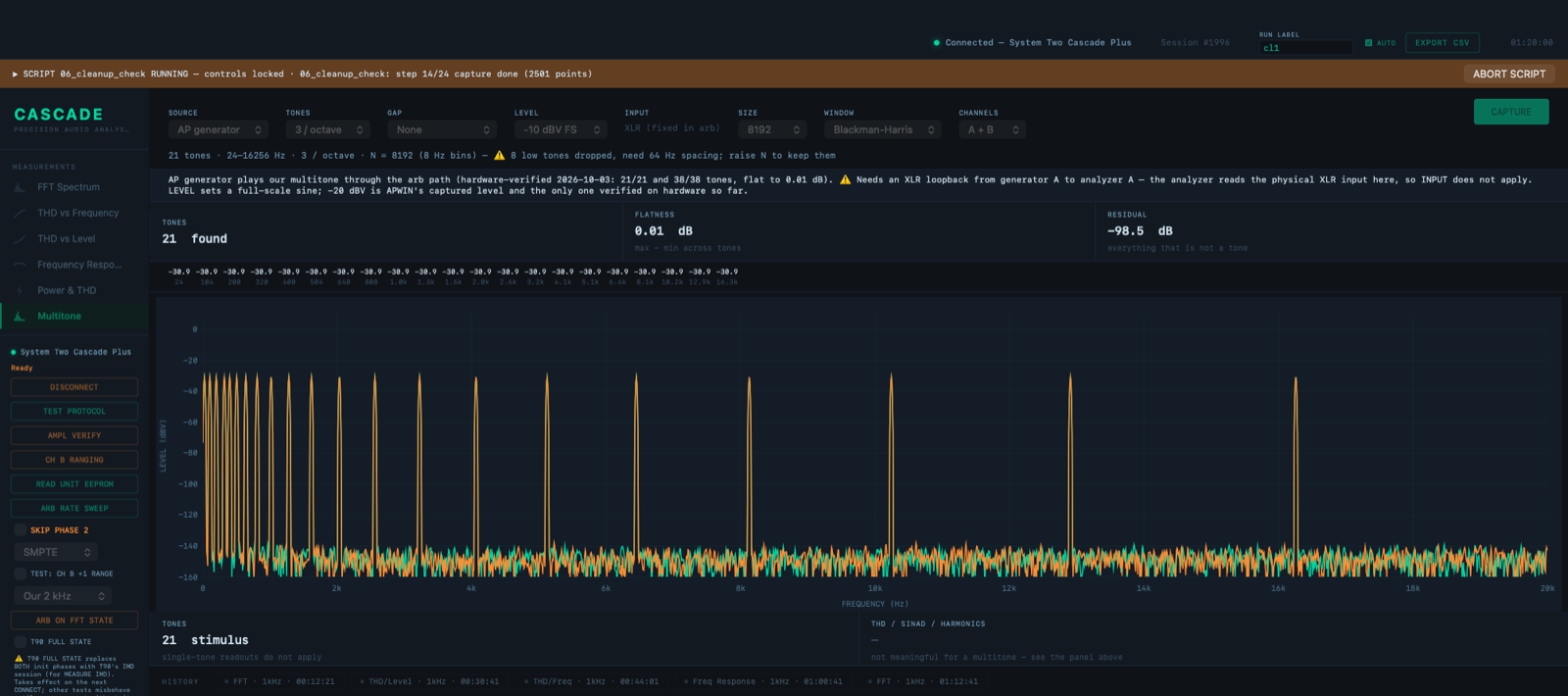
Status. Hardware-verified: 21 of 21 and 38 of 38 tones found, flatness 0.01 dB, scope agreed. The LEVEL control was checked at −20, −10 and 0, with tones within ±0.02 dB and Ch B matching Ch A to 0.006 dB. Open problem: the arb capture fails intermittently, about 1 run in 8 (weak or silent signal, then a timeout). A fix is proposed and waiting on Chris's go.